
Why Is Quick Shut-Off Capability of Butterfly Valves Essential for Turbine Protection?
On a steam turbine trip, the stop valve closes in less than a second. But the isolation valve upstream may still be open, and the energy stored in the upstream piping continues to push steam toward the machine. On a hydro turbine, a load rejection can send the unit into overspeed while the inlet valve is still travelling. On a gas turbine fuel gas skid, a downstream fire or flame-out demands isolation before the fuel inventory can sustain the event. In each case, the Butterfly Valve is often the final isolation element, and its shut-off speed determines how much energy reaches the turbine before the system is isolated. A valve that closes in fifteen seconds instead of three seconds may be the difference between a controlled trip and a damaged machine.
The quick shut-off capability of a Butterfly Valve is essential for turbine protection because it limits the duration of energy input after a protective action has been initiated. It reduces overspeed exposure, limits water hammer and overpressure when the closure is properly staged, and protects the turbine blades, bearings, and seals from the consequences of prolonged abnormal flow. But quick shut-off is not a single number on a datasheet. It is the result of the quarter-turn valve design, the actuator selection, the valve sizing, and the control philosophy. This article explains why shut-off speed matters, how the Butterfly Valve achieves it, what determines the actual closing time, and how buyers should verify the performance before placing an order. Our factory at Dafugui Pipe Valve Co., Ltd. manufactures Butterfly Valves for turbine isolation and control, and the guidance below reflects the engineering and procurement questions we address with our customers.
Table of Contents
- 1. What Happens to a Turbine When Shut-Off Is Delayed?
- 2. Why Does the Butterfly Valve's Quarter-Turn Design Matter for Shut-Off Speed?
- 3. How Do Actuator Selection and Valve Sizing Determine Actual Shut-Off Time?
- 4. What Role Does Quick Shut-Off Play in Water Hammer and Overpressure Protection?
- 5. How Should Buyers Verify Quick Shut-Off Performance Before Ordering?
- 6. Frequently Asked Questions (FAQ)
- 7. Conclusion
1. What Happens to a Turbine When Shut-Off Is Delayed?
A turbine is protected by a chain of actions: the protection system detects an abnormal condition, the trip system commands the stop valves to close, and the isolation valves limit the upstream energy that can continue to feed the event. If the isolation Butterfly Valve is slow to close, the turbine continues to receive energy after the trip. The consequences depend on the machine type, but the mechanism is the same: prolonged energy input converts a controlled shutdown into an overspeed, an overpressure, or a thermal event. The timeline below describes the sequence for a typical steam turbine trip with a delayed isolation valve.
- t = 0 s: The protection system detects an overspeed, low lube oil pressure, or high vibration condition and issues a trip command.
- t = 0.2 to 0.5 s: The stop valve closes and interrupts the main steam flow to the turbine.
- t = 0.5 to 3 s: The upstream isolation Butterfly Valve is still open. Steam stored in the piping between the isolation valve and the stop valve continues to bleed into the machine.
- t = 3 to 15 s: If the isolation valve is slow, the stored energy continues to accelerate the rotor or to raise the pressure in the casing. Bearing temperature and axial thrust rise.
- t > 15 s: The rotor may reach overspeed trip again, or the casing pressure may exceed the design limit. The risk of blade rub, seal damage, and bearing failure increases with every second of delay.
The table below summarizes the protection consequences of delayed shut-off for three turbine types.
| Turbine Type | Energy Source After Trip | Consequence of Delayed Isolation | Protection Priority |
| Steam turbine | Stored steam in upstream piping | Overspeed, casing overpressure, thrust rise | Limit stored energy release |
| Hydro turbine | Water inertia in penstock | Overspeed, water hammer, draft tube surge | Controlled closure with pressure limit |
| Gas turbine fuel skid | Fuel gas inventory in piping | Fire, explosion, downstream overheat | Isolate fuel inventory quickly |
For a procurement team, the lesson is that the isolation Butterfly Valve is part of the turbine protection logic, not a general-purpose block valve. The shut-off time must be specified against the protection study, not selected from a catalogue default. Our factory at Dafugui Pipe Valve Co., Ltd. works with turbine packagers and plant engineers to specify Butterfly Valve shut-off performance against the stored energy and the transient limits of the system. The goal is to make the isolation valve an active part of the protection chain, not a passive boundary.
2. Why Does the Butterfly Valve's Quarter-Turn Design Matter for Shut-Off Speed?
The Butterfly Valve is inherently suited to quick shut-off because its closure element is a disc that rotates through 90 degrees. The quarter-turn motion means that the valve does not require a long stem travel or a multi-turn actuator. The disc moves from the fully open position to the closed position in a single rotation, and the closing time is limited mainly by the actuator and the fluid forces rather than by the valve's mechanical travel. This is why Butterfly Valves are used in turbine isolation, compressor anti-surge, and other applications where the isolation action must be fast and predictable.
However, the quarter-turn design is not sufficient on its own. The disc geometry affects the torque profile, the seating design affects the final seal, and the flow characteristics affect the dynamic forces during closure. The table below compares the quarter-turn Butterfly Valve with a multi-turn gate valve in a turbine isolation duty.
| Parameter | Butterfly Valve | Gate Valve |
| Stroke | 90 degrees rotation | Multi-turn stem travel |
| Typical closing time with actuator | 1 to 10 s depending on size | 10 to 60 s depending on size |
| Actuator type | Pneumatic spring-return, electric, hydraulic | Electric multi-turn, gear operator |
| Footprint | Compact, wafer or lugged | Long face-to-face |
| Seating | Soft seat or metal seat | Metal seat |
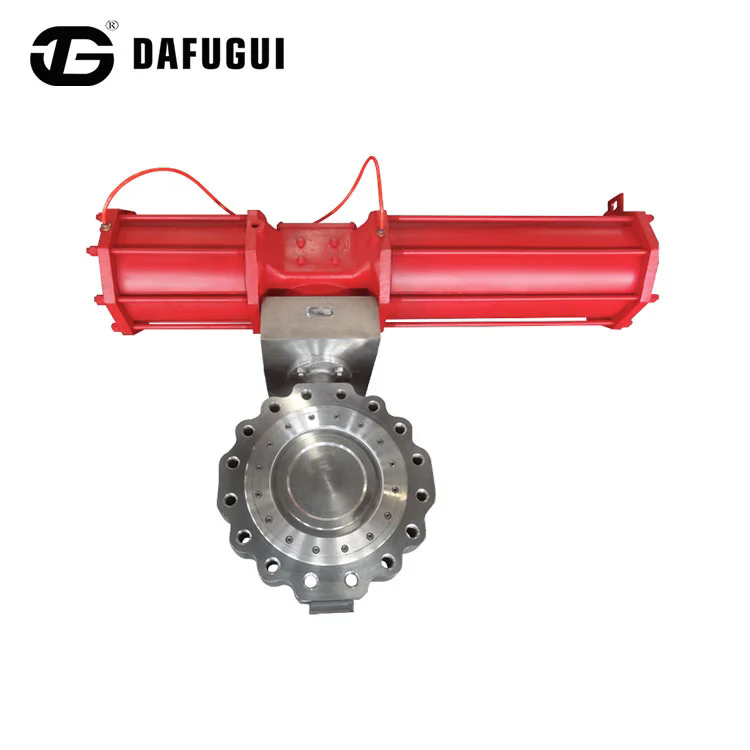
The quarter-turn design also simplifies the implementation of a fail-safe closing action. A spring-return pneumatic actuator can be configured so that the loss of air or power drives the valve to the closed position. The spring energy is released over a 90-degree stroke, and the closing time can be adjusted with the actuator sizing and the flow control valves. This fail-safe behavior is a key reason why Butterfly Valves are preferred for turbine isolation. Our factory at Dafugui Pipe Valve Co., Ltd. supplies Butterfly Valves with spring-return pneumatic, electric, and hydraulic actuation, and we help our customers select the actuation that matches their protection philosophy.
For a buyer, the quarter-turn design is a starting point, not a guarantee. The actual shut-off time depends on the actuator torque, the valve torque, the fluid forces, and the control scheme. A quarter-turn valve with an undersized actuator can be slower than a multi-turn valve with a properly sized actuator. The procurement specification must state the required closing time and the conditions under which it is to be achieved, not just the valve type.
3. How Do Actuator Selection and Valve Sizing Determine Actual Shut-Off Time?
Actuator selection and valve sizing determine the actual shut-off time because the valve must overcome the torque produced by the flowing fluid as the disc moves toward the seat. In a Butterfly Valve, the torque is not constant through the stroke. It rises as the disc approaches the seat, and it is affected by the pressure drop, the flow velocity, and the compressibility of the fluid. The actuator must provide enough torque to close the valve against this torque profile with a margin. If the actuator is undersized, the closing action may stall or slow down near the seat, and the valve may not reach the closed position within the required time. The table below summarizes the parameters that determine the closing time.
| Parameter | Effect on Closing Time | Typical Specification Range | Procurement Check |
| Valve size | Larger disc mass and higher torque | DN50 to DN2000 | Confirm size against flow and pressure drop |
| Pressure class | Higher pressure increases seating torque | PN10 to PN40, Class 150 to 300 | Confirm the design pressure and differential |
| Actuator torque | Higher torque allows faster closure against load | Output torque with 1.5x safety factor | Request torque calculation |
| Actuator type | Spring-return, electric, hydraulic | Pneumatic 1-3 s, electric 5-15 s | Confirm the required fail-safe mode |
| Closing profile | Two-stage closure reduces water hammer | Fast initial, slow final 20 degrees | Confirm the control philosophy |
| Fluid density | Higher density increases dynamic torque | Water, steam, gas | Confirm the fluid data in the torque calculation |
The closing profile is a design feature that is often overlooked in procurement. A valve that closes in three seconds at full speed may create a pressure surge that is more damaging than the event it was intended to protect. A two-stage closure, where the disc moves quickly through the first 70 to 80 degrees and then slows for the final 10 to 20 degrees, limits the surge while still achieving rapid isolation. Our factory at Dafugui Pipe Valve Co., Ltd. can supply Butterfly Valves with pneumatic actuators and positioning systems that implement a two-stage closure profile. The goal is to match the shut-off speed to the transient limits of the system, not to close as fast as possible.
For a buyer, the actuator and valve sizing should be documented in a torque calculation that covers the full stroke, including the seating torque and the dynamic torque. The calculation should state the assumed fluid conditions and the safety factor. A supplier that provides only a valve datasheet and no torque calculation is a supplier that is leaving the shut-off performance to chance. The procurement specification should require the torque calculation as part of the order documentation.
4. What Role Does Quick Shut-Off Play in Water Hammer and Overpressure Protection?
Quick shut-off plays a dual role in water hammer and overpressure protection. On one hand, fast isolation is necessary to limit the energy that feeds a turbine overspeed or a fuel gas fire. On the other hand, fast closure of a liquid-filled line can generate a pressure surge that damages the piping, the valve, and the turbine inlet components. The two requirements must be balanced by the closure profile and the system design. A Butterfly Valve that is closed too slowly may fail to protect the turbine. A Butterfly Valve that is closed too quickly may create a water hammer that exceeds the system pressure rating. The table below summarizes the relationship between closure time and transient response for a hydro turbine inlet.
| Closure Time | Transient Effect | Protection Implication | Recommended Approach |
| Very fast (1-2 s) | High water hammer pressure rise | Risk of pipe or valve damage | Use two-stage closure or surge relief |
| Moderate (3-8 s) | Controlled pressure rise | Good balance of isolation and surge | Verify against transient analysis |
| Slow (10-30 s) | Low surge, but prolonged energy input | Overspeed risk | Not suitable for critical isolation |
| Very slow (> 30 s) | Minimal surge | Inadequate turbine protection | Use only for normal shutdown |
The water hammer effect is not limited to hydro turbines. In a steam system, fast closure of a Butterfly Valve can create a pressure wave that propagates back to the boiler or the header. In a fuel gas system, fast closure can create a pressure surge that trips the upstream compressor. The protection philosophy must account for these effects, and the valve closure profile must be selected accordingly. Our factory at Dafugui Pipe Valve Co., Ltd. supports our customers with closure profile options and with the valve sizing data needed for transient analysis. The goal is to make the Butterfly Valve part of a controlled protection scheme, not an uncontrolled source of transient energy.
For a buyer, the water hammer question should be addressed in the procurement specification. The specification should state the maximum allowable pressure rise and the closure profile that achieves it. The supplier should provide the valve’s flow characteristics and the actuator’s closing time so that the buyer’s transient analysis can verify the design. A supplier that cannot provide this data is a supplier that cannot support the protection study.
5. How Should Buyers Verify Quick Shut-Off Performance Before Ordering?
Buyers should verify quick shut-off performance by requiring a documented shut-off time, a torque calculation, and a factory test report. The verification should cover the valve, the actuator, and the control system as a single assembly. The table below provides a procurement verification checklist for a turbine isolation Butterfly Valve.
| Verification Item | What to Request | Acceptance Criterion |
| Shut-off time | Factory test report with measured closing time | Within the protection study limit |
| Torque calculation | Full-stroke torque with safety factor | Actuator output exceeds valve torque by 1.5x |
| Fail-safe mode | Spring-return or stored-energy documentation | Matches the plant protection philosophy |
| Closure profile | Two-stage or linear profile description | Meets the transient pressure limit |
| Seat leakage | API 598 or ISO 5208 test report | Rate A or specified class |
| Material certificates | Body, disc, stem, seat material traceability | Per the specified grade |
The factory test report should be performed on the complete valve-actuator assembly, not on the valve alone. The test should measure the closing time under the specified supply pressure and, where possible, with a simulated load. The report should state the test conditions, the measured time, and the pass or fail result. Our factory at Dafugui performs the assembly test and provides the report with the Butterfly Valve shipment. We also provide the torque calculation and the seat leakage report as part of the documentation package. The goal is to give buyers the evidence they need to confirm that the valve will perform its protection role.
For a buyer, the verification should also include a review of the supplier’s quality system and the actuator supplier’s qualification. A Butterfly Valve with a well-made body and a low-quality actuator is not a reliable protection element. The procurement team should confirm that the actuator is sourced from a qualified supplier and that the assembly is tested as a system. This is the final step that turns a specification into a protected turbine.
6. Frequently Asked Questions (FAQ)
Question 1: How fast should a turbine isolation butterfly valve close?
Answer: The required closing time depends on the turbine type, the stored energy in the upstream system, and the allowable transient pressure rise. For many steam and gas turbine isolation applications, a closing time in the range of 1 to 5 seconds is specified. For hydro turbines, the closure is often staged over 5 to 15 seconds to limit water hammer. The correct value should come from the protection study, not from a catalogue default.
Question 2: Does a faster closing butterfly valve always provide better turbine protection?
Answer: Not necessarily. A closing time that is too fast can create a pressure surge that damages the piping, the valve, or the turbine inlet components. The objective is a controlled closure that isolates the turbine within the protection limit while keeping the transient pressure within the system design. A two-stage closure profile is often used to achieve both goals.
Question 3: What is the difference between soft-seated and metal-seated butterfly valves for turbine isolation?
Answer: A soft-seated Butterfly Valve uses an elastomeric or PTFE seat and provides tight shut-off at lower temperatures. A metal-seated Butterfly Valve uses a metal-to-metal seal and is suitable for higher temperatures and more severe service. For steam turbine isolation, metal-seated valves are often specified because of the temperature. The seat selection should match the fluid temperature and the required leakage class.
Question 4: How can I confirm the actuator is sized correctly for quick shut-off?
Answer: Request a full-stroke torque calculation that includes the dynamic torque, the seating torque, and a safety factor. Confirm that the actuator output torque exceeds the calculated valve torque by at least 1.5 times. Confirm that the actuator is tested with the valve as an assembly, and that the measured closing time meets the protection study limit. A supplier that cannot provide the torque calculation is a supplier that cannot confirm the shut-off performance.
Question 5: What documentation should accompany a butterfly valve order for turbine protection?
Answer: The documentation should include the factory assembly test report with the measured closing time, the torque calculation, the fail-safe mode description, the closure profile description, the seat leakage test report, and the material certificates. These documents allow the buyer to verify that the valve meets the protection requirements and to support the plant’s safety case.
7. Conclusion
The quick shut-off capability of a Butterfly Valve is essential for turbine protection because it limits the energy that reaches the machine after a trip, reduces overspeed and overpressure exposure, and supports the overall protection philosophy. The quarter-turn design provides the mechanical basis for fast closure, but the actual performance depends on the actuator sizing, the valve torque, the closure profile, and the control system. For procurement teams, the specification should state the required closing time, the allowable transient pressure, the fail-safe mode, and the documentation that proves the performance. Our factory at Dafugui Pipe Valve Co., Ltd. supplies Butterfly Valves for turbine isolation with spring-return pneumatic, electric, and hydraulic actuation, and we provide the torque calculation, the assembly test report, and the seat leakage data that buyers need to verify the shut-off performance. If you are sourcing a Butterfly Valve for turbine protection, contact our team to discuss your closing time requirement and the transient limits of your system.
Contact Dafugui Pipe Valve Co., Ltd. today to discuss your Butterfly Valve requirements for turbine protection and to request the shut-off performance documentation for your application.
Related News
- What Makes Metal-Sealed Butterfly Valves Ideal for High-Velocity Hydro Turbine Service?
- What Role Do Butterfly Valves Play in Protecting Pumps from Surge Pressure Events?
- Why Do Desalination Plant High Salinity S32760 Threaded Pipe Flanges Excel in SWRO Brine and Chemical Lines?
- How Does a Butterfly Valve Control Water Flow in Municipal Supply Systems?
- What Role Do Butterfly Valves Play in Hydropower Plant Penstock Flow Regulation?
- What Is a Rubber Disc Check Valve and How Does It Ensure Reliable Backflow Prevention?
Leave me a message
News Recommendations