
Threaded Rubber Expansion Joint
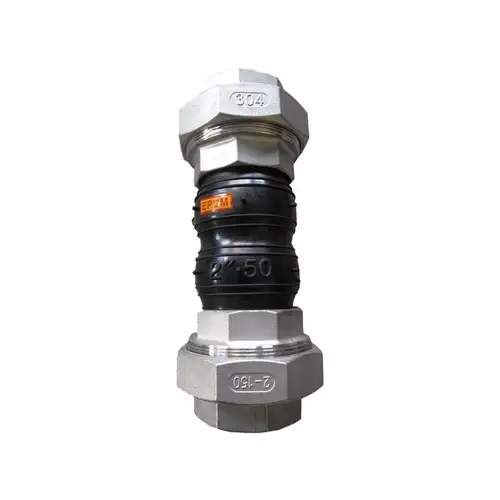
Dafugui, offers in-stock supply and affordable wholesale services for Threaded Rubber Expansion Joints. Also known as threaded rubber flexible joint, union rubber joint, or vibration isolator, this product consists of a rubber sphere body (inner rubber layer, nylon cord fabric reinforcement, outer rubber layer) combined with metal union threaded ends, molded through high-temperature, high-pressure vulcanization. Featuring threaded connection, small size, light weight and flexible installation, it effectively compensates for axial, lateral and angular displacements caused by thermal expansion/contraction and equipment vibration, while providing excellent vibration damping and noise reduction. Widely used in central air conditioning fan coil units, hot water units, pump suction/discharge connections, fire protection and chemical small-diameter pipeline systems.
Threaded Pipeline Connection
Threaded Rubber Expansion Joint is a compact flexible pipe connector designed for small-diameter piping systems. Dafugui offers in-stock supply and wholesale services for threaded rubber expansion joints. Also known as threaded rubber flexible joints, union rubber joints, or vibration isolators, these connectors combine an elastic reinforced rubber sphere with metal union threaded ends. The structure accommodates pipeline movement, absorbs equipment vibration, and helps reduce transmitted noise in HVAC, water circulation, pump connections, fire protection, and chemical pipeline installations.
Threaded Rubber Expansion Joint for Wholesale and Industrial Pipeline Projects
Product Construction
Flexible Rubber Sphere with Threaded Metal Connections
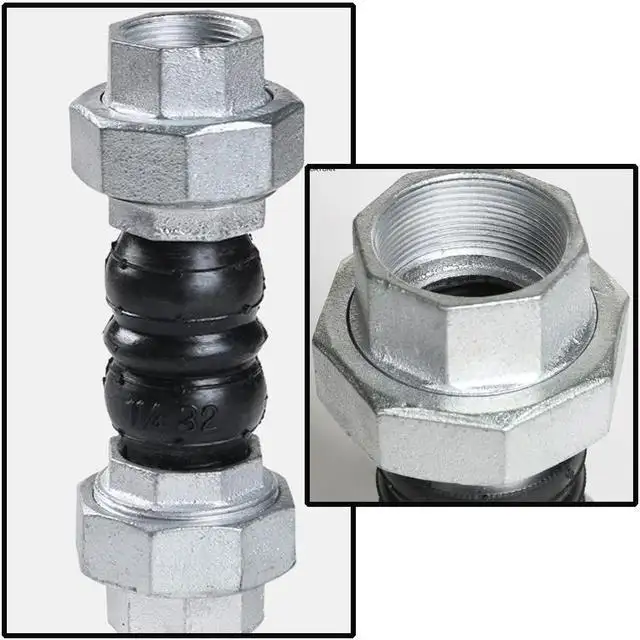
The product consists of an inner rubber layer, nylon cord fabric reinforcement, and an outer rubber layer, combined with metal union threaded ends. The assembly is molded through high-temperature, high-pressure vulcanization.
Its threaded connection eliminates the need for flange drilling and bolt alignment. This makes it suitable for compact pipe layouts where installation access and maintenance space are limited.
DN15–DN80 Nominal diameter range
0.25–2.5 MPa Working pressure range
3 Types Single sphere, double sphere and elbow
2 Options Galvanized carbon steel or stainless steel unions
Technical Specifications and Connection Configuration
The following specifications summarize the available product information. Buyers should confirm the required diameter, pressure rating, connection material, rubber compound, and operating medium before placing a bulk order.
| Product Name | Threaded Rubber Expansion Joint |
|---|---|
| Alternative Names | Threaded Rubber Flexible Joint, Union Rubber Joint, Vibration Isolator |
| Structure | Single sphere, double sphere, and elbow types |
| Nominal Diameter | DN15–DN80 mm |
| Working Pressure | 0.25–2.5 MPa |
| Rubber Layers | Inner rubber layer, nylon cord fabric reinforcement, and outer rubber layer |
| Rubber Materials | NR, NBR, EPDM, CR, FKM |
| Union Materials | Galvanized carbon steel or stainless steel 304/316L |
| Manufacturing Process | High-temperature, high-pressure vulcanization molding |
| Applicable Standard | GB/T 26121 |
| Manufacturer | Dafugui Pipe Valve Co., Ltd., Wenzhou, Zhejiang, China |
Rubber and Metal Material Selection for Different Media
The rubber compound and metal union should be selected according to the conveyed medium, operating temperature, pressure, and surrounding environment. Dafugui provides several material options for different pipeline conditions.
NR – Natural Rubber
Used for water and air applications. Its elastic characteristics make it suitable for flexible connections and vibration absorption in compatible operating conditions.
NBR – Nitrile Rubber
Selected for oil-related applications where resistance to oil-based media is an important material requirement.
EPDM – Ethylene Propylene Diene Monomer
Suitable for applications involving acids, alkalis, hot water, and outdoor exposure, subject to compatibility with the specific medium and operating conditions.
CR and FKM
CR and FKM are additional rubber material options. FKM is intended for applications requiring higher temperature and chemical resistance, subject to compound specifications.
Metal Union Selection
Galvanized carbon steel is a standard option for compatible non-corrosive services. Stainless steel 304 or 316L can be considered where greater corrosion resistance is required. Confirm material grade against the actual medium and installation environment.
How the Threaded Connection Simplifies Installation
Unlike flanged rubber expansion joints, the threaded type connects directly to compatible threaded pipeline ends. It does not require a separate flange assembly, bolt tightening sequence, or flange-hole alignment. This connection arrangement is particularly useful for small-diameter pipelines and equipment connections in restricted spaces.
- Check the pipeline connection Confirm the nominal diameter, thread compatibility, connection dimensions, and available installation clearance.
- Verify material compatibility Match the rubber compound and metal union material with the operating medium, pressure, and temperature.
- Install the threaded ends Screw the union ends directly into the compatible pipeline connections and tighten evenly using an appropriate wrench.
- Inspect the sealing condition Check the thread sealing arrangement and inspect the connection for leakage after initial pressurization.
For threaded connections, PTFE tape can be applied where appropriate to the thread sealing design. Excessive tightening should be avoided. Proper installation and compatibility checks help reduce leakage risks and simplify later maintenance.
Vibration Absorption and Pipeline Movement Compensation
The high-elasticity rubber sphere and reinforced nylon cord fabric work together to absorb vibration and impact generated by connected equipment. The flexible structure also compensates for axial, lateral, and angular displacement caused by thermal expansion, contraction, and equipment operation.
In pump systems, the joint helps isolate vibration transmitted through the pipeline and reduce structure-borne noise. It also provides buffering against operating impacts and alternating thermal movement. The actual movement capacity depends on the selected product configuration and operating conditions.
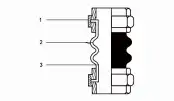
Threaded rubber expansion joint construction and reinforced rubber sphere
Where Threaded Rubber Expansion Joints Are Used
Threaded rubber expansion joints are designed for small-diameter piping connections in building services, equipment systems, and industrial installations. Their compact structure and flexible connection make them suitable for the following applications.
Central Air Conditioning Systems
Flexible connections for fan coil units and air-conditioning terminals, helping absorb equipment vibration.
Hot Water Circulation
Inlet and outlet pipeline connections for hot water units and compatible circulation systems.
Pump Pipeline Connections
Small pump suction and discharge connections, including flexible connections around pipeline bends.
Fire Protection Pipelines
Flexible connections for compatible small-diameter fire protection branch lines.
Chemical Pipeline Systems
Small-diameter pipelines conveying compatible chemical media, subject to rubber and metal material selection.
Typical installation applications for threaded rubber expansion joints
Applicable Media and Operating Conditions
The product information identifies the following media as potential applications: seawater, fresh water, hot and cold water, drinking water, domestic sewage, crude oil, fuel oil, lubricating oil, finished oil, air, gas, steam (temperature ≤250℃), and granular powder.
Media compatibility must be checked against the selected rubber compound, metal union, actual temperature, pressure, and chemical concentration. The stated steam temperature is not a universal operating rating for every rubber compound or product configuration. Buyers should obtain confirmation for the specific operating conditions before selection.
Frequently Asked Questions About Threaded Rubber Expansion Joints
Q1. What is the difference between threaded and flanged rubber expansion joints?
Threaded joints connect through threaded ends and have a compact structure, making them suitable for DN15–DN80 mm small-diameter pipelines and confined installation spaces. Flanged joints use flange bolts and are commonly selected for larger pipeline connections and applications requiring a flanged interface. The selection should also consider the actual pressure rating, connection dimensions, and system requirements.
Q2. Are threaded rubber expansion joints prone to leakage?
Leakage risk depends on thread compatibility, sealing method, installation quality, and operating conditions. Use an appropriate wrench to tighten the connection evenly and apply PTFE tape where suitable for the thread design. Inspect the joint after initial pressurization and retighten if necessary. Dafugui states that its products undergo pressure testing to verify sealing performance.
Q3. How should I choose the metal union material?
Galvanized carbon steel can be used for compatible non-corrosive media such as water and air. Stainless steel 304 or 316L is recommended for applications requiring greater corrosion resistance or involving more demanding environments. The final selection should be based on the conveyed medium and actual service conditions.
Q4. What rubber materials are available?
The available rubber material options include NR, NBR, EPDM, CR, and FKM. Each material has different compatibility characteristics. The buyer should provide the medium, temperature, and pressure requirements so that the appropriate compound can be evaluated.
Q5. What information should I provide when requesting a wholesale quotation?
Provide the nominal diameter, required working pressure, rubber material, metal union material, conveyed medium, operating temperature, required quantity, and application. Drawings or connection details can also help clarify the required configuration.
Related Rubber Joint and Pipeline Products
For projects requiring different connection arrangements or movement compensation structures, explore Dafugui's Rubber Joint product range and Valve category. You can also browse the full product catalog to compare other pipeline components.
Request a Threaded Rubber Expansion Joint Quotation
Contact Dafugui Pipe Valve Co., Ltd. with your diameter, pressure, rubber compound, union material, operating medium, and order quantity requirements. Our team can review the application details and help identify a suitable threaded rubber expansion joint configuration for your project or wholesale purchasing plan.
Send Inquiry
Contact Info
-
Address
No.25 Xingchao Road, Sidao'er Road, Binhai Park, Longwan District, Wenzhou City, Zhejiang Province, China
-
Tel
-
Email
Dafugui is a leading China manufacturer and supplier of flanges, valves, and pipe fittings since 2006. Welcome to our website! For inquiries about our products or pricelist, please leave your email to us and we will be in touch within 24 hours.
Related Products
News Recommendations